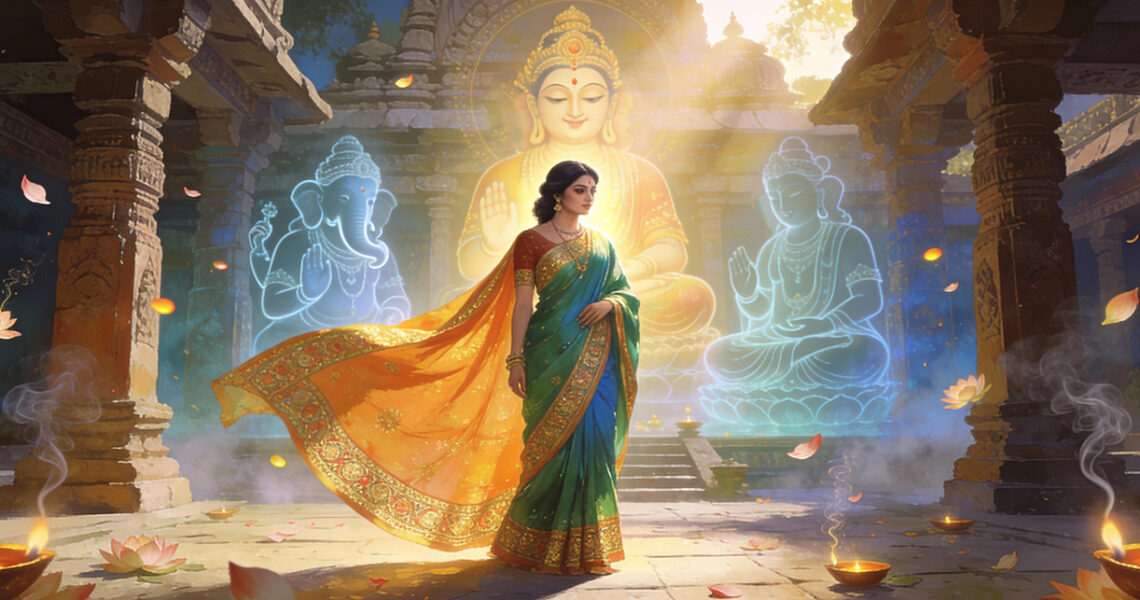
Yatra Naryastu Pujyante, Ramante Tatra Devatah”
The Eternal Vision of Womanhood in Sanatan Dharma
The Shloka
यत्र नार्यस्तु पूज्यन्ते रमन्ते तत्र देवताः ।
यत्रैतास्तु न पूज्यन्ते सर्वास्तत्राफलाः क्रियाः ।।
— Manusmriti, Chapter 3, Verse 56
Origin of the Shloka
This profound verse comes from the Manusmriti, one of the most ancient and authoritative legal–philosophical texts of Sanatan Dharma. Manusmriti discusses ethics, social harmony, duties, and spiritual principles that guide human life.
Within this framework, the status of women is not treated as secondary or symbolic but as fundamental to prosperity, harmony, and spiritual success.
Meaning of the Shloka
English Meaning
Where women are respected and honored, the divine forces rejoice there.
Where women are not honored, all actions—religious, social, or material—become fruitless.
Hindi Meaning
जहाँ नारी का सम्मान और पूजा होती है, वहाँ देवताओं का वास होता है।
जहाँ नारी का अपमान होता है, वहाँ किए गए सभी कर्म निष्फल हो जाते हैं।
Bhavarth (Deeper Inner Meaning)
This shloka goes beyond ritualistic worship. It conveys a deeper truth:
Respect for women is not optional morality—it is a spiritual law.
Sanatan Dharma teaches that cosmic balance, social stability, and spiritual progress depend upon how women are treated. When women are empowered, protected, and respected, positive energies flourish. When they are neglected or dishonored, even the most elaborate religious acts lose their meaning.
In essence, divinity does not dwell in temples alone—it resides where women are honored.
Female Power as Shakti: The Creative Force of the Universe
In Sanatan philosophy, Shakti is the primal energy of the universe—the force that creates, sustains, and transforms existence.
Without Shakti, even Shiva is described as Shava (inert).
Woman is not merely a supporter of creation; she is creation itself.
She gives birth to life
She nurtures consciousness
She shapes society
She preserves culture
Shakti is not limited to physical creation—it extends beyond the visible world, into knowledge, wisdom, intuition, and spiritual awakening.
Importance of Women in Human Life and Society
In Sanatan thought, a woman plays multiple sacred roles simultaneously:
As a mother, she is the first guru
As a daughter, she carries future generations
As a wife, she is a partner in dharma
As a teacher and thinker, she transmits wisdom
As Shakti, she sustains the universe
A society that uplifts women becomes compassionate, balanced, and progressive. A society that suppresses women gradually collapses—morally, socially, and spiritually.
Five Powerful Examples from Sanatan Culture
1. Devi Worship (Shakti Upasana)
Sanatan Dharma uniquely worships the Divine as female—Durga, Lakshmi, Saraswati, Kali. The Supreme is not gender-exclusive; it is profoundly feminine in energy.
2. Women Rishikas of the Vedas
The Rig Veda, the oldest known scripture of humanity, includes hymns composed by women sages such as:
Gargi Vachaknavi
Maitreyi
Lopamudra
Apala
Ghosha
This is unparalleled in world history.
3. Gargi’s Philosophical Debate
Gargi fearlessly questioned Yajnavalkya on the nature of Brahman in royal assemblies—proving that women were philosophers, not followers.
4. Saraswati: Goddess of Knowledge
Knowledge itself is personified as a woman. Learning, speech, wisdom, and creativity are all rooted in feminine energy.
5. Ardhanarishvara Concept
The divine form where Shiva and Shakti share one body, teaching that masculine and feminine energies are incomplete without each other.
A Unique Truth: Sanatan Dharma and Women in Scriptures
Sanatan Dharma is the only spiritual tradition whose ultimate scriptures:
Contain hymns written by women
Recognize women as seers (Rishikas)
Worship the Divine in feminine form
Treat Shakti as supreme cosmic power
No other religious or philosophical tradition in the world places women at the very foundation of creation, knowledge, and liberation in such depth and continuity.
Conclusion
“Yatra Naryastu Pujyante” is not merely a verse—it is a civilizational vision.
It reminds humanity that:
Respecting women is respecting creation
Empowering women is empowering society
Honoring Shakti is honoring life itself
Where women are valued, civilizations rise.
Where women are ignored, even prayers fall silent.
Sanatan Dharma does not just speak of women’s empowerment—it is built upon it.