The Essence of Shakti
In Indian spiritual thought, Shakti is the eternal cosmic energy—the power of creation, preservation, and transformation. She is not just worshipped as a Goddess, but understood as the very force that animates the universe. Navaratri, meaning “Nine Nights,” is dedicated to this divine power, reminding us that the same Shakti resides within every living being.
Myth and Symbolism
The central story of Navaratri is the battle between Goddess Durga and Mahishasura, the buffalo demon. The name Mahishasura Mardini is made up of:
Mahisha = buffalo
Asura = demon
Mardini = the one who slays or destroys
Thus, Mahishasura Mardini means “the Goddess who slays the buffalo demon.”
The Battle Story
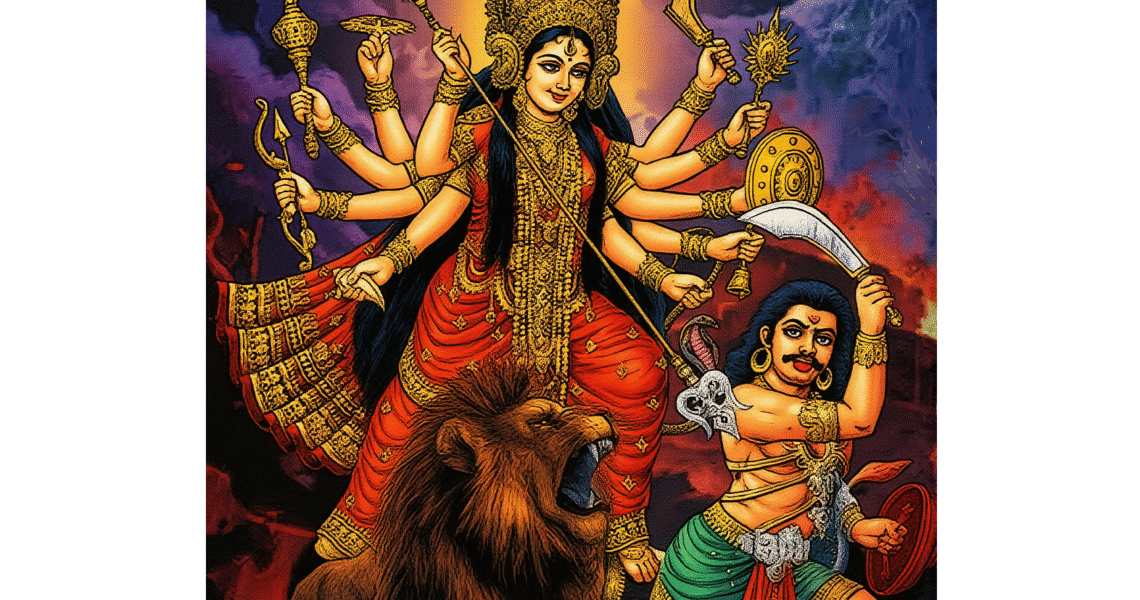
According to the Puranic tale, Mahishasura, empowered by a boon, became arrogant and terrorized the heavens and earth. When he approached Goddess Durga, they fought face to face. At first, he tried to overpower her, but soon the Goddess gained the upper hand. With her divine weapons and unstoppable energy, she bashed the demon fiercely, leaving him shaken.Mahisha began to retreat. But Devi, unwavering, struck at the right moment and finally slew him.
The Evolution of Mahishasura in Art
Over centuries, artists and sculptors have shown Mahishasura in changing forms:
Early depictions (ancient sculptures): Mahisha shown as a full buffalo, emphasizing brute strength.
Later depictions (medieval temple art): Mahisha shown with a buffalo head and human body, symbolizing a mix of animal instinct and human ego.
Modern depictions (idols, paintings, festivals): Mahisha shown as a human demon, with the buffalo often present by his side, making the story more relatable.
This evolution reflects how society visualized the inner battle—transforming raw instinct into human form to make the moral lesson clearer.
Navaratri in Today’s World
While rooted in spirituality, Navaratri is now a grand cultural festival:
In Gujarat, Garba and Dandiya nights light up the season with rhythm and color.
In West Bengal, Durga Puja brings artistic pandals, rituals, and cultural celebrations.
In South India, families arrange Golu displays, depicting myths and traditions.
In North India, Ramlila dramas bring the Ramayana alive, with Dussehra marking the burning of Ravana.
Shakti in the Modern World
In our fast-paced lives, Navaratri is a reminder to awaken Shakti within. Just as Devi stood firm against Mahishasura, we too can face challenges—fear, doubt, ego, negativity—and overcome them with strength, clarity, and compassion.
Conclusion
From the cosmic idea of Shakti, to the battle of Mahishasura Mardini, to the joyful Navaratri Utsav, this festival is both spiritual and cultural. It celebrates the Goddess not only as a divine slayer of demons but also as the strength within us.
As the depictions of Mahishasura evolved—from buffalo to hybrid to human—the essence of the story remains timeless: evil may challenge upfront, retreat when confronted, but Shakti always prevails.
References & Further Reading
. Scriptural Basis
The story of Durga and Mahishasura comes from the Devi Mahatmya (part of the Markandeya Purana, 400–600 CE). That is the primary authentic text.
It clearly describes Mahishasura’s approach, his transformations (buffalo → lion → elephant → man), and Devi slaying him.
This is the root source for all later tellings, temples, and art.
2. Archaeological & Artistic Evidence
The evolution of Mahishasura’s form (buffalo → hybrid → human demon) is visible in temples and sculptures across India:
Udayagiri caves (5th century CE): early Durga slaying Mahisha as a buffalo.
Mahishasuramardini Mandapa, Mamallapuram (7th century CE): hybrid buffalo-head demon.
Durga Puja idols (modern): human-like demon with buffalo symbol.
These shifts are documented in art history and museum collections (e.g., The Met Museum, Smarthistory, ASI records).
3. Academic & Historical Validation
Scholars and historians (e.g., Stella Kramrisch, Devangana Desai) have written on how Durga and Mahishasura appear in literature, art, and temple iconography. Their research authenticates the symbolic and evolving depictions.
4. What I Did in the Blog
I wrote the blog in simple, reader-friendly language.
The facts (meaning of Mahishasura Mardini, battle sequence, animal transformations, sculpture evolution) are aligned with scriptural + archaeological sources.
To make it robust for your audience, you can add a “References / Further Reading” section at the end with links like:
Devi Mahatmya (Markandeya Purana)