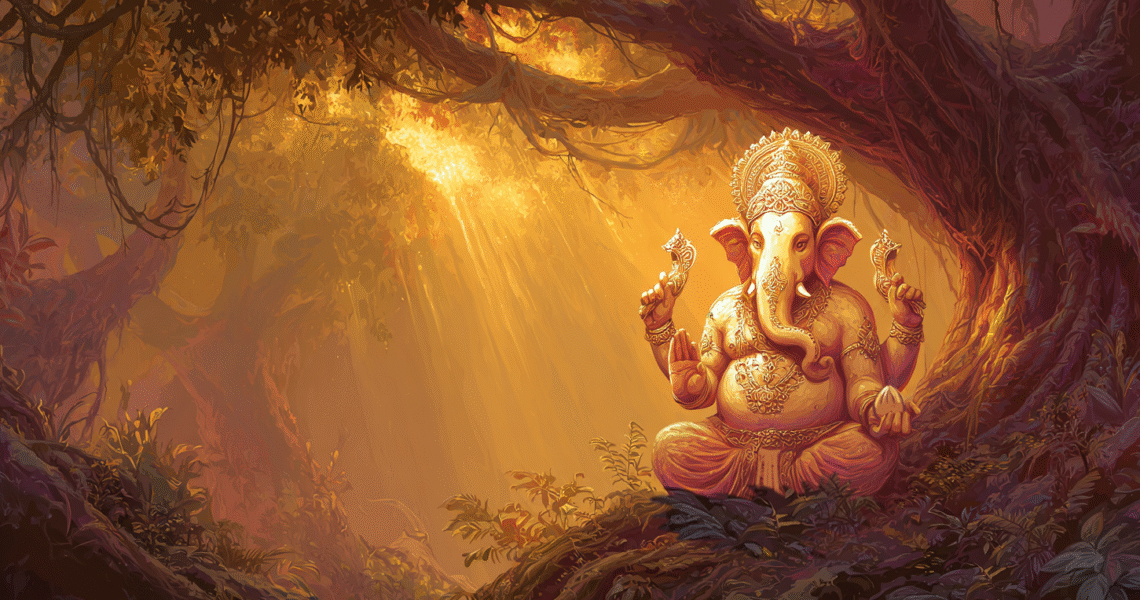
Shri Ganesh: origin, tattva, symbolism, geography, history & the global journey

25/08/2025 By Dhai Se Padhai

why the world begins with “ganapati bappa morya”

Across India—from Kashmir’s valleys to Kanyakumari’s shores—life events start with the name of Ganesha, the remover of obstacles and patron of wisdom, arts, and new beginnings. But how did an elephant-headed, human-bodied form come to embody so much? Let’s travel through origin stories, spiritual philosophy (Ganesh tattva), striking symbolism, the rise of Sarvajanik Ganeshotsav, archaeology across continents, and parallels in other cultures.

origins: from vedic echoes to classical images

  • In the Vedas: the word “Ganapati” (leader of hosts) appears in the Rigveda 2.23.1, though scholars note it may refer to Brahmanaspati/Brhaspati rather than our later Ganesha—showing an early seed of the idea. Encyclopedia

  • Upanishadic deification: the Ganapati Atharvaśīrṣa (a late Upanishad tied to the Atharva Veda) proclaims Ganesha as Brahman, the Supreme Reality—an important foundation for “Ganesh tattva.” The text is listed in the Muktikā canon (compiled c. 17th century). vedantastudents.comWikipedia

  • Earliest images: archaeologists generally place the first dateable Ganesha sculptures in the Gupta era (4th–6th c. CE)—for example at Mathura—with the form spreading rapidly in early medieval India (Udayagiri, Elephanta, Badami, etc.). WikipediaPeepulTree Worldindia-seminar.com
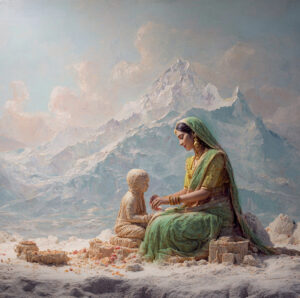
Ganapati in the Vedas: The Earliest Mantras and Their Meaning

The earliest references to Ganapati are found in the Rigveda, where he is invoked not as the elephant-headed deity of later Puranas, but as a revered leader of groups, the lord of wisdom and prayer. A famous verse from the Rigveda (2.23.1) says:

गणानां त्वा गणपतिं हवामहे कविं कवीनामुपमश्रवस्तमम् ।
ज्येष्ठराजं ब्रह्मणां ब्रह्मणस्पता आ नः शृण्वन्नूतिभिः सीद सादनम् ॥

Transliteration:
Gannānaam Tvaa Ganna-Patim Havaamahe
Kavim Kaviinaam-Upama-Shravastamam
Jyessttha-Raajam Brahmannaam Brahmannaspata
Ā Nah Shrnvan-Uutibhih Siida Saadanam

Meaning:
“We invoke You, O Ganapati, the Lord of all groups, the seer among seers, the most renowned and wise. You are the eldest of the gods, the lord of prayers and sacred wisdom. Please come to us with your blessings and sit here among us.”

Another important mantra appears in the Rigveda (10.112.9):

नि षु सी॑द गणपते ग॒णेषु॒ त्वामा॑हु॒र्विप्र॑तमं कवी॒नाम् ।
न ऋ॒ते त्वत्क्रि॑यते॒ किं च॒नारे म॒हाम॒र्कं म॑घवञ्चि॒त्रम॑र्च ॥

Transliteration:
ni ṣu sīda gaṇapate gaṇeṣu
tvām āhur vipratamaṁ kavīnām
na ṛte tvat kriyate kiṁ canāre
mahām arkam maghavañ citram arca

Meaning:
“O Ganapati, sit among the gatherings. You are called the wisest among the wise. Without you, nothing is undertaken or accomplished. Accept our great hymn of praise and worship with delight.”

These mantras show that the Ganapati concept originates in the Vedas as the principle of wisdom, guidance, and leadership of divine hosts. The later Puranic stories—such as Ganesha’s birth, elephant head, and his role as remover of obstacles—are Itihasa-Purana narratives that expand, symbolize, and personify the original Vedic essence into rich mythology that continues to inspire devotees today.

the birth of Ganesha (puranic narratives)

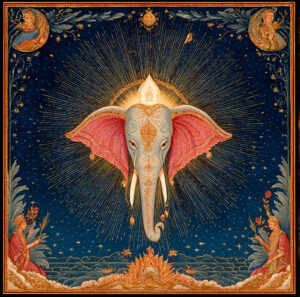
Classic Puranic tellings vary, but a popular version says Parvati fashioned a child from sandalwood or clay to guard her, Shiva beheaded him in a misunderstanding, and later restored him with the head of a divine elephant—granting boons that made him Pratham Pujya (first-worshipped). These stories aren’t about biology; they’re metaphors for spiritual truths explained below.
what is “Ganesh tattva”?

Tattva means principle/essence. In yoga and tantra, Ganesha is:

  • Guardian of the threshold—the deity of beginnings who presides over the mūlādhāra (root) chakra: stability, safety, grounding.

  • Integrator of opposites—elephant (power/memory) + human (intellect) symbolizes harmonizing instinct and reason.

  • Embodiment of Brahman—as in the Atharvaśīrṣa: the one reality appearing as all forms. Practically, invoking Ganesha means aligning intention + attention so obstacles turn into stepping stones. Wikipedia

🌟 The Story of Ganesh and Kartikeya: Wisdom over Speed

This beautiful story from the Puranas illustrates how our scriptures taught the greatness of parents:

One day, Narada Muni gifted a divine fruit to Lord Shiva and Parvati and suggested it should be given to only one of their sons – either Kartikeya or Ganesha – the one who proved to be the wisest.

To test them, Lord Shiva asked:
“Whoever goes around the world three times first will win the fruit.”

Kartikeya instantly mounted his peacock and zoomed across the world. Meanwhile, Ganesha calmly folded his hands, walked around his parents three times, and declared:

“For me, my parents are my whole world.”

Moved by his wisdom and devotion, Shiva and Parvati awarded the divine fruit to Ganesha.

This story isn’t just a tale – it’s a symbol of the Sanatan value system, where honoring one’s parents is greater than conquering the world.

Symbolism of Beheading & Elephant-Head Replacement

  1. Cutting of the Ego (Beheading)

    • The human head in the story represents the limited ego, pride, and narrow identity that resists higher wisdom.

    • Shiva (Supreme Consciousness) cuts it off, symbolizing the dissolution of ahamkāra (ego-self) so that a new, divine identity can emerge.

    • It shows that true wisdom begins when the small “I” is removed.

  2. Transformation, not Destruction

    • Beheading is not annihilation but a passage: an old form of consciousness is removed to make space for a higher, expansive one.

    • This reflects the universal truth that growth requires letting go of the old self.

  3. Elephant Head as Higher Consciousness

    • The elephant’s head replaces the limited human one to signify expanded awareness, strength, wisdom, and memory.

    • Unlike the cut-off human head that was born from clay (earth-bound, fragile), the elephant head is divine and powerful—a new consciousness gifted by the gods.

    • Thus, the story teaches that divine wisdom must govern the body, not ego-driven intellect.

  4. Union of the Two Forces

    • The child (Parvati’s creation) represents Shakti (Energy).

    • The intervention of Shiva (Consciousness) brings transformation.

    • The new Ganesha becomes the perfect integration of Shakti + Shiva: energy guided by higher awareness.

  5. Obstacle and Resolution

    • The “obstacle” (beheading) itself becomes the pathway to transformation.

    • Without the loss of the human head, the divine elephant-headed form would never emerge.

    • This encodes the message: every obstacle hides an opportunity for greater evolution.


✨ In short:
The beheading symbolizes ego-death and breaking the limitation of ordinary identity, while the elephant head replacement symbolizes the gift of higher wisdom, cosmic intelligence, and a new beginning blessed by the divine.
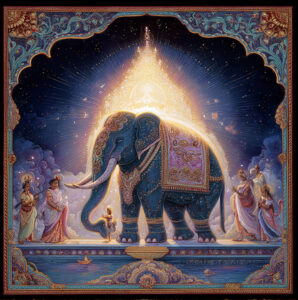
decoding the symbolism: why an elephant head on a human body?

  • Large head: think big; cultivate buddhi (intelligence) & viveka (discernment).

  • Small eyes: focus.

  • Large ears: listen more; sift wisdom from noise.

  • Curved trunk: adaptability—able to uproot a tree or pick a needle.

  • Round belly: capacity to ‘digest’ life’s opposites.

  • Broken tusk (ekadanta): sacrifice the ego; retain what serves truth (it’s also linked to writing the Mahābhārata).

  • Mouse (vāhana): the restless mind/desire—kept as a vehicle, not a master.

  • Modaka: the inner sweetness (ānanda) that follows disciplined effort.
Tracing Ganesh Festival: From Chhatrapati Shivaji Maharaj’s Era to Tilak’s Movement

The roots of public Ganesh worship in Maharashtra are traced in different ways. Some say that Chhatrapati Shivaji Maharaj (1630–1680) encouraged Ganesh devotion as a unifying force of Swarajya, though we don’t find direct historical references to a formal Ganesh festival during his reign. What is clear is that under the Peshwas of Pune (18th century)—themselves ardent Ganesh devotees—the festival grew in grandeur, with Shaniwar Wada’s Kasba Ganpati becoming the “gram daivat” (chief deity) of Pune. By the late 19th century, Shri Bhau Rangari, a freedom-minded social worker in Pune, is remembered as the first to install a public (sarvajanik) Ganesh idol in 1892 with the image of Ganesha slaying a demon, symbolizing resistance to oppression. Inspired by this momentum, Lokmanya Bal Gangadhar Tilak in 1893 institutionalized the Sarvajanik Ganeshotsav, turning the once private household ritual into a mass public celebration that united people across caste and class against the British Raj.

how a home ritual became a people’s movement

For centuries, Ganesh Chaturthi was largely a domestic/temple ritual. In 1893, Lokmanya Bal Gangadhar Tilak transformed it into the Sarvajanik (public) Ganeshotsav in Pune—creating a legal, cultural platform for community unity, discourse, arts, and anti-colonial organization under the British. WikipediaThe Indian ExpressIndian Culture

side-note on present relevance: the festival’s public character continues to evolve. In July 2025, Maharashtra officially recognized the 10-day Ganeshotsav as the state festival, underscoring its social and cultural role. The Times of India

from Kashmir to Kanyakumari: a pan-Indian presence

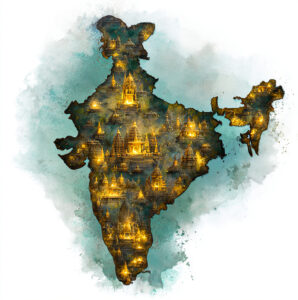
There is scarcely a district in India without a Ganesha shrine—ancient cave reliefs, medieval temple icons, roadside shrines, and modern mandals. Whether in Kashmir’s old Shaiva locales or Kanyakumari’s coastal temples, Ganesh worship unites linguistic regions and sects (Shaiva, Shakta, Vaishnava, Smarta, even Jaina communities in later centuries). Wikipedia+1

archaeology: Ganesha across the world

Beyond India, traders, monks, and artisans carried Ganesha’s image along maritime and land routes. Key finds include:

  • Afghanistan (Gardez): a famous inscribed Ganesha statue (now dated around the 7th–8th c. CE, Turk Shahi period), showing Greco-Buddhist influences and Sanskrit-Brahmi inscriptional links. WikipediaFree Press Journal

  • Indonesia (Java & Bali): abundant statues from 9th–11th c. CE (e.g., Prambanan region; museum pieces dated 10th–11th c.). Ganesha remains prominent in Balinese Hinduism today. Wikipediacollections.artsmia.orgTheCollector

  • Vietnam (Champa): superb Cham sculptures of Ganesha from Mỹ Sơn (4th–13th c. complex; see MET collection piece). UNESCO World Heritage CentreThe Metropolitan Museum of Art

  • Thailand: revered as Phra Phikanet/Phra Phikanesuan and even appears on the emblem of Thailand’s Fine Arts Department—with a living cult linking Ganesha to arts and learning. nationthailand

  • Japan: in esoteric Buddhism, Ganesha becomes Kangiten—often a dual-bodied embracing form symbolizing bliss and unity—popular in Shingon/Tendai traditions since the time of Kūkai (774–834). Wikipedia+1onmarkproductions.com

(These are examples; Ganesha images also appear in Sri Lanka, Nepal-Tibet, and pockets of Myanmar and Cambodia.) Wikipedia

similarities with other countries & civilizations

  • shared functions: across Southeast & East Asia, Ganesha is consistently tied to removing obstacles, good fortune, and patronage of arts/learning—even when embedded in Buddhist contexts. Thailand explicitly honors him as a protector of arts & culture; Japan’s Kangiten embodies bliss and prosperity. nationthailandWikipedia

  • iconographic adaptation: local styles alter ornaments, mudrās, and attributes, but retain the elephant head + human body core (sometimes two-bodied in Japan). Wikipedia

  • civilizational transmission: the spread followed trade & monastic networks from the Gupta-Pāla heartlands via the Bay of Bengal and overland Buddhist routes—why we find Ganesha in port-connected cultures like Champa and Java. UNESCO World Heritage Centre

a quick timeline

ganesha today: timeless, yet contemporary

  • Civic unity: public mandals still double as platforms for community service, cultural education, and social causes—echoing Tilak’s intent. Wikipedia

  • Creative inspiration: from classical dance to design and startup culture (think “remover of obstacles” energy), Ganesha remains a shorthand for beginning well.

conclusion

Shri Ganesha’s journey is both inward—as the tattva of clarity, steadiness, and auspicious beginnings—and outward—visible in stone and bronze from Mathura to My Son, Prambanan to Tokyo shrines. The elephant head and human body remind us to marry strength with sensitivity, memory with imagination, and to start every new path with humility and joy.

references & further reading (selected)